Chinese Navy
World War ZThe Chinese Navy is presented not simply as a military organization but as a repository of national continuity during the Z-world conflict. Its officers insist that their decision to abandon China was not treason: they loved their country and people, remained loyal to their leadership, and acted only when the existing war effort threatened to erase the population those institutions were meant to protect. That contradiction—obedience to the state versus preservation of the civilization beneath it—defines the organization’s most important appearance in the narrative.
Identity and Wartime Position
The Chinese Navy operates within a wider defense structure dominated by an army that repeatedly claims the crisis is under control. As the dead spread through every city and village across China’s vast territory, army commanders continue to promise that each day marks a turning point and that national pacification is imminent. The naval perspective treats this confidence as a dangerous form of institutional overreach: an army can be assembled from people given uniforms, brief training, and something resembling a weapon, but mass mobilization alone does not create an adequate answer to the undead.
The Navy’s officers therefore occupy a position of constrained professional judgment. They are not depicted as detached from the nation or eager to escape responsibility. Their allegiance is emotional, political, and historical, yet it is tested against the evidence of total collapse. The organization’s defining question becomes whether preserving a functioning crew, a strategic vessel, and a remnant of Chinese knowledge can serve the country more faithfully than dying within a failing chain of command.
The Submarine Exodus
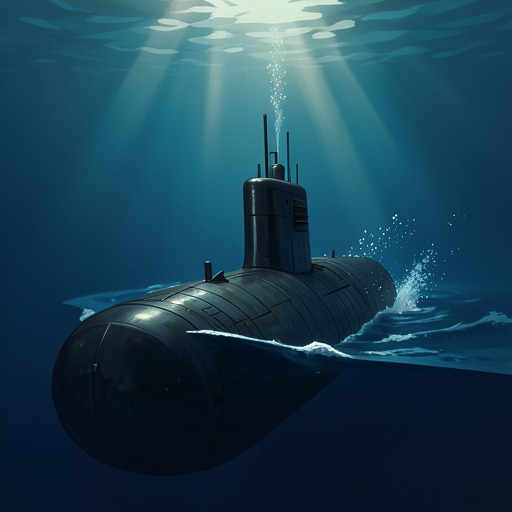
The decisive action associated with the Chinese Navy is the theft and escape of the Admiral Zheng He, a ballistic-missile submarine and the newest of China’s Type 94 vessels. The boat is described as one of only three such submarines, the most expensive, advanced, and powerful machine China had built. Its construction embodied Russian assistance, black-market technology, the results of espionage against the United States, and nearly five thousand years of continuous Chinese history. Taking it was consequently not a minor act of desertion but the appropriation of one of the motherland’s most valuable national assets.
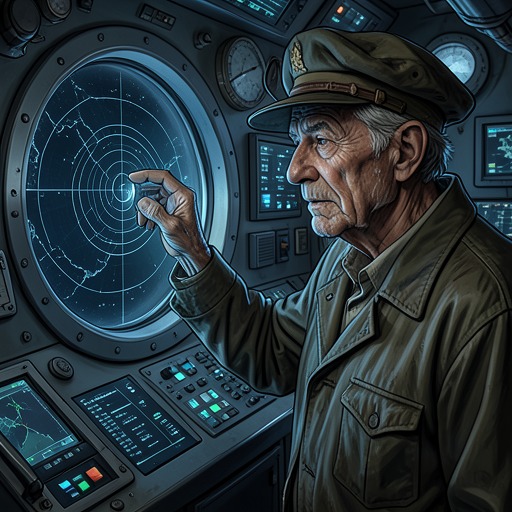
Captain Chen proposes the escape after concluding that continued war will leave no Chinese people and perhaps no people anywhere. Senior officers initially regard the plan as inconceivable, but Captain Chen’s force of personality and fanatical patriotism persuade them that flight may be the only remaining alternative. The escape is prepared over three months while Qingdao remains under constant siege. Army units are repeatedly brought in to maintain order, each less trained, less equipped, younger, or older than the last; the naval perimeter is attacked almost daily; and the crew must provision a supposedly routine patrol while secretly loading emergency supplies and family members.
Families are not an incidental addition to the plan. Captain Chen understands that the crew will not leave port unless their relatives can accompany them, making kinship the practical condition of naval obedience. The preparation thus converts a military departure into a collective act of survival. The submarine carries not merely personnel and matériel but the social units that give the crew a reason to preserve life beyond the immediate battle.
The exodus becomes an armed flight when the Admiral Zheng He witnesses the destruction of the Madrid Spirit. A missile strikes the gas carrier, producing a fireball that destroys life on the two nearest motus. The narrator first suspects an accident, but Commander Song identifies the streak of the missile, and the submarine’s crew realizes that the attack came from another Chinese submarine. They cast off, cut power lines, count heads, secure the hatches, and dive to battle stations because remaining in place would expose civilian islanders to further attacks.
At ninety meters, the submarine deploys its towed-array sonar and detects the hull-popping noises of another vessel changing depth. The sound identifies a brittle titanium hull rather than steel; only the Russian Federation and China use titanium hulls in attack submarines, and the blade count confirms that the contact is a new Type 95 hunter-killer. Two are in service when the Admiral Zheng He leaves port, but the crew cannot determine which one is pursuing or observing them. The unanswered significance of that uncertainty preserves the escape’s atmosphere of danger: the Navy is not merely withdrawing from a ruined country but navigating the possibility of conflict with its own surviving forces.
Doctrine, Resources, and Adaptation
Elsewhere in the wartime military system, the failure at the Battle of Yonkers demonstrates the danger of applying conventional assumptions to the undead. Troops are placed on the ground behind sandbags and in fighting holes rather than on the roofs and upper floors that would have provided commanding views of the valley and protection from attack. Engineers even blast fighting holes for tanks in the A&P parking lot. The arrangement reflects defensive habits shaped by earlier wars instead of the actual behavior of the enemy.
The ammunition crisis is equally revealing. Commanders fail to calculate the rounds required for sustained artillery, rocket, and tank operations. Abrams tanks carry only three canister rounds in a forty-round loadout, while armor-piercing depleted-uranium darts and other conventional ammunition achieve little against walking corpses. The Chinese Navy belongs to the same broader lesson in military adaptation: advanced platforms matter only when doctrine, logistics, and strategic purpose match the threat.
The post-Yonkers military culture consequently adopts the resource-to-kill ratio associated with General Travis D’Ambrosia. Systems are judged by the number of undead they can eliminate for the resources they consume, and soldiers begin comparing weapons by cost and lethality rather than prestige. This principle favors reliable, scalable tools such as the Standard Infantry Rifle and its Cherry PIE ammunition, whose pyrotechnically initiated explosive rounds shatter inside a zombie’s skull and destroy the brain without requiring decapitation or wasteful burning.
The same adaptive logic appears in battlefield formations. Forces advance in two solid lines, one behind the other, across the continent. Under Force Appropriate Response, only the number of troops necessary to eliminate a small group or a single crawling corpse halts, while the secondary line fills the gap so the front never breaks. The method is slow—advancing from the Rockies to the Atlantic takes three years—but it ensures that no ground is casually skipped and that the army’s strength is not squandered on disproportionate responses.
Technology and Institutional Reuse
The war repeatedly repurposes equipment designed for other missions. Zeus, originally a compact laser system for clearing mines and unexploded bombs from a specialized Humvee, becomes a weapon against the undead. Its beam can burn through a bomb casing, detonate its explosive contents, or, at higher settings, punch through a zombie’s forehead; at lower settings it boils the brain until it erupts through the ears, nose, and eyes. The contrast between the weapon’s original engineering purpose and its battlefield use illustrates how institutions survive by redirecting existing technologies rather than waiting for perfect inventions.
Other projects expose the limits of technological optimism. Project Yellow Jacket promises micro-missiles, millions roughly the size of .22 rimfire bullets, scattered from transport aircraft and guided by satellites to the brains of every zombie in North America. The proposal theoretically could win the war within forty-eight hours, but its failure leaves behind regret over the resources consumed and the alternative weapons those resources might have produced. The project stands opposite the resource-to-kill ratio: a spectacular concept can become strategically wasteful when theoretical reach outruns practical value.
The same tension governs systems maintained beyond Earth. The Jules Verne Three ATV, originally a one-way supply vehicle intended to return as trash and burn up in the atmosphere, is modified with manual controls and a pilot’s couch. ASTRO, designed as an orbital refueling station for military, surveillance, and later civilian satellites, is adapted to keep a wider satellite network functioning. The Chinese Navy’s submarine exodus belongs to this pattern of institutional reuse on a more existential scale: a machine built to represent national power is transformed into a lifeboat for people and knowledge.
Significance and Legacy
The Chinese Navy’s significance lies in the moral ambiguity of its survival. The officers neither celebrate abandonment nor deny the enormity of what they take. They understand that the Admiral Zheng He embodies the state’s wealth, technological achievement, and historical continuity, yet they also recognize that preserving those achievements may require removing them from the state’s collapsing territory. Their action makes loyalty practical rather than ceremonial: the nation is treated as something that can survive in a crew, a family network, a vessel, and the knowledge carried through the darkness.
Against the army’s repeated assurances of control, the Navy’s decision is an admission that institutions can preserve civilization only by acknowledging when their existing strategy has failed. Its officers respond to collapse not with empty confidence but with preparation, secrecy, kinship, and a willingness to repurpose national power for survival. The resulting image is neither a simple indictment nor a clean vindication. The Chinese Navy becomes one of the narrative’s clearest examples of an organization forced to choose between the command it serves and the future it believes that command has ceased to protect.